
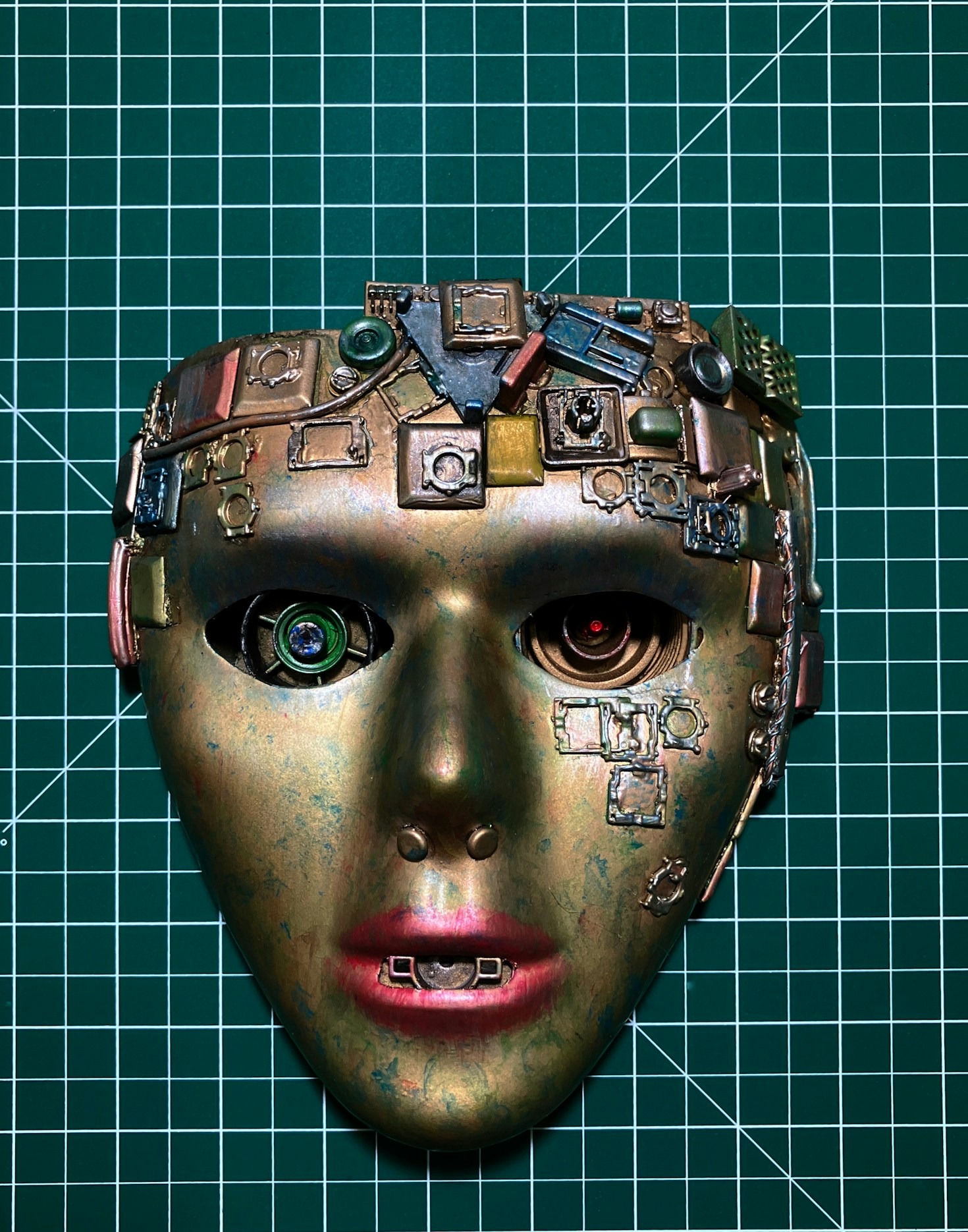
the technology
a neural interface built around the human head.
At the center of BinaryBrainWaves is a conceptual neural mesh: a wearable structure designed to fit around the user’s head and position sensors in strategic locations for monitoring brain activity.
The objective is to capture neurological signals, process them computationally, identify meaningful patterns, and translate those patterns into machine-readable information.
The result is a proposed pipeline:
brain activity → sensors → signal processing → pattern recognition → digital representation
At the most fundamental level, computers work with information represented digitally.
BinaryBrainWaves asks:
Can meaningful information from the brain eventually be represented in the same digital language?
the mesh
The mesh is envisioned as a flexible wearable platform rather than a bulky laboratory machine.
Potential components could include:
- neural activity sensors
- signal amplification hardware
- onboard processing
- wireless connectivity
- machine-learning algorithms
- calibration systems
- modular expansion connectors
The exact sensor technology would depend on the neurological signals being measured and the requirements of the application.
The goal is a platform capable of collecting rich neurological data while remaining comfortable enough for extended use.
the signal
The brain doesn’t produce thoughts as neat strings of ones and zeroes.
That’s where the real engineering challenge begins.
Neural activity is complex, noisy, continuous, and highly individual.
BinaryBrainWaves therefore imagines multiple layers of processing between the raw neurological signal and the final digital representation.
layer 01 — capture
Sensors collect measurable neurological activity.
layer 02 — filtering
Signal-processing systems separate useful neurological information from noise and interference.
layer 03 — interpretation
Algorithms identify patterns within the processed signals.
layer 04 — personalization
The system learns the characteristics of the individual user.
layer 05 — digital mapping
Recognized patterns can be represented as structured digital information.
layer 06 — application
Software interprets that information according to the purpose of the system.
The same underlying interface could therefore support very different applications.
modular intelligence
One of the most interesting possibilities is the concept of neural modules.
Think of them as software cartridges.
A physical or digital module could provide a specialized experience while the underlying neural interface remains the same.
education
Language learning.
Memory exercises.
Interactive training.
Skill development.
communication
Interfaces designed to assist people who cannot communicate through conventional physical means.
rehabilitation
Systems that monitor neurological responses during rehabilitation and potentially provide clinicians with additional information about patient engagement and response.
research
Tools for studying how humans respond to information, stimulation, learning environments, and interactive systems.
the ultimate goal
BinaryBrainWaves isn’t about pretending the brain is a computer.
It is about building technology capable of interfacing with the brain without requiring the brain to become something else.
The challenge is enormous.
The potential is equally enormous.
And the first step is understanding the signal.